 Film Reviews: Jun 2012

The Beatles’ mythology has become so ingrained in our culture that even I, a self-confessed Beatle nut, rarely have the energy anymore to restate or reexamine their history. If my kids have questions about the Fabs, I’m almost half-tempted to sigh and say, “Yes, they were four guys who all lived in a funhouse together. If they ventured outside for groceries, they’d hop in their Yellow Submarine while being chased by screaming fans. Yes, Paul was the cute one, John was the smart one, George was the quiet one, and Ringo was the minotaur at the end of the maze—so, who wants to listen to some Motorhead?” Sexy Intellectual and MVD Entertainment have released a new DVD called Strange Fruit: The Beatles’ Apple Records. The obvious fine print on all such releases like these is the standard “This Film is not sanctioned by Apple Records or The Beatles,” so let’s just get that out of the way. Let’s also dispense with the almost-forgivable fact that the makers of this DVD titled it “Strange Fruit,” which is of course the classic title of the Billie Holiday song that is one of the musical bedrocks of the Civil Rights movement. Accidentally gauche, but OK, let’s move on. As someone who has spent a good chunk of his life’s money on all manner of Beatle-related stuff—some great, some middling, and some undeniably crap in retrospect—it’s a relief to discover a new Beatle-related product that is of supreme quality. Strange Fruit, quite frankly, is high-caliber documentation on a period of Beatles history that is usually otherwise spooned out in a lumpy form in books and DVDs. Even The Beatles’ own amazing Anthology series compressed the Apple period and didn’t allow the story to breathe, thoughtfully and intelligently, as it does here in Strange Fruit. In 1968, after the death of manager Brian Epstein (probably the initial death knell for the band), The Beatles launched Apple, their own company ostensibly comprising a record label, publishing arm, and even a clothing boutique. John Lennon had raised the Apple flag as a sort of artistic “up yours” to The Man, where all and sundry artists could be welcomed at Apple without having to go into someone else’s corporate office and beg for funding. In truth, as the documentary makes clear, Apple was also a bit of a legal tax dodge, somehow enabling the Fabs to take less of a hit to the Taxman (nod to George) by bundling some of their affairs under a hippie-corporate aegis. Now most of the truncated histories about Apple start from its conception, whip through the short-lived boutique period, and go straight to iron-fisted, tough-talkin’ New Yawka Allen Klein (the next Beatles manager who was sort of the anti-Epstein). Strange Fruit, on the other hand, emphasizes and reflects how this was a Golden period, albeit brief, for several artists that The Beatles took under their wing for their newly christened Apple Records label. Even as The Beatles were embroiled in the growing tensions during their White Album creation, it’s evident that as individuals The Beatles (some at least) were able to separate their own band-related woes from their caring interest in others’ careers. And this is what Strange Fruit does so well: It paints a portrait of The Beatles as nurturers, in a professional, non-fawning way. We get the testimony of recording artist Jackie Lomax, previously of The Undertakers during the initial Mersey Beat wave, who had been rediscovered by George Harrison. And it’s easy to see why George had an affinity for Lomax, since he too was a Liverpudlian gifted with working-man’s wit and also shared George’s soft-spoken, keenly observant countenance. The 67-year-old Lomax sits before the camera and even now conveys the palpable sense of a young man’s excitement at not just being discovered by a Beatle (then like a blessing from the gods) but because he was being taken seriously as an artist. In addition, Strange Fruit plots the detailed trajectory of The Iveys who were later renamed Badfinger. They were a hothouse flower (but blindingly talented and unique in their own right, sans Beatle blessing) quickly cultivated by Paul McCartney. McCartney created another instant sensation in Mary Hopkin, who took the frail, Fairport-Convention-type of sound into the Top 10 with “Those Were The Days.” The credo of “many more of them live next door,” from “Yellow Submarine,” seemed to be alive and well in those heady days of new acquisitions for Apple (let’s not forget the then-unknown James Taylor on the roster). Even the record logo—a crisp Granny Smith apple shown full on the A side and then cut in half on the B-side—symbolized a sort of purity of vision and acceptance; it was also an implied stamp of good quality. Apple is one of the first childhood words that kids learn and they’re oh-so-healthy to eat; pure subliminal marketing. Naturally, the Apple story takes the downward arc, as The Beatles rapidly deteriorate and their outside interests in Apple also take a nosedive. However, this documentary handles that obvious historical point with graceful élan; even fruit turns bad eventually. What must be made absolutely clear is that Strange Fruit is PBS-worthy for viewing. It’s not a quickie, slapdash cash-in, but rather a sophisticated, entirely engaging documentary that deserves a wide audience. And to be even bolder, I’d recommend that Apple actually officially sanction this work because it’s completely deserving of that stamp of approval.
Strange Fruit is out today via Sexy Intellectual and MVD Entertainment. You can order it directly from See Of Sound.
This article originally appeared in Popshifter
|
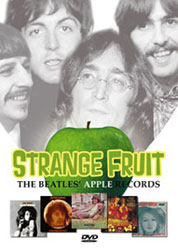 An Apple A Day Keeps The Maharishi Away: Strange Fruit DVD