|
Interview with Silent Partner
Intro:
EC: What is your musical background? David James: I started out with guitar lessons at about age 8 or 9, then took up percussion at age 12. At about age 15, I became interested in piano, and started taking some classical piano lessons. At that point I was interested in learning everything I could about guitar, piano, and drums, but I soon decided to let the guitar fall back into the "hobby" department, and just focus on the piano and drums - mainly drums. I went to Cincinnati College-Conservatory of Music as a percussion major, dropping out after a year and a half to form a band. Kemp Jones: I took some piano lessons when I was very young and played drums in the school band for a while. In high school I played in a band that covered popular songs. We played everything from soul music (James Brown, Temptations, Four Tops) to psychedelic (Cream, Jimi Hendrix). Our best covers were the pop hits of the time. Rascals, Creedence, Buckinghams, Box Tops, Who, BeeGees etc. EC: What was the first song you wrote and what was it about? David James: I don't remember what it was, but I'm sure it was about some girl I was hung up on at the time, LOL. Kemp Jones: I think "Good Bye Friends" was the first song that I wrote. The title describes it. I wrote poems early on and used melodies of songs I knew for the rhythm of poems. I would replace the lyrics with my own words. EC: What was the reason for you to start your first band, how was it called and what kind of music did they play? David James: The first serious band I was in was the one I started as I was leaving Cincinnati College-Conservatory in 1975. It was called Solstice, and we played progressive rock in the vein of Emerson, Lake, and Palmer, Yes, etc. We also played whatever more popular music (Doobie Brothers, Eagles, etc.) we had to play in order to get gigs. We wanted to be part of the progressive rock scene, but we just couldn't afford to keep going, not to mention the fact that we had a great deal of personality conflict within the band. Kemp Jones: In High School the band I played in with Don, a member of Silent Partner, was the Oxfords. We started the band because we were really excited about music. At the time music was becoming more of cultural phenomenon and the power of popular music was being discovered. There was much experimentation at the time and the young were driving much of that movement. EC: How and when did Silent Partner get together? David James: Since I was not there in the very beginning, I don't actually know - and I don't remember much of what I was told at the time, other than that it was a group of friends who just wanted to write songs together, probably originating around 1974 or 1975. And there were one or two other guys who had come and gone by the time I came around. By the time I joined in early 1978, the other 4 members were in place (Kemp Jones, Don Porterfield, Ben Bickerstaff, and David Shew), and they were playing around the South-eastern US, without a drummer. A friend of mine heard them play one night, met them, and he thought I'd fit right in with them. So I went down and heard them the next night, met them, and jammed with them at rehearsal the following afternoon. This was in Birmingham, Alabama - about a 4 1/2 hour drive from Athens, where Silent Partner lived. They were wanting to add a drummer, so we agreed to keep in touch and see if we could bring it together in the not-too-distant future. A few weeks later I got a gig in Atlanta (much closer to Athens) and I began driving up to Athens once a week to rehearse with Silent Partner. It still was not determined whether I would be joining the band full-time - we were still just checking each other out. After a couple of months of this, they asked me to join, and I moved to Athens. This was in early 1978. Kemp Jones: Ben Bickerstaff and I left home in Atlanta and attended the University of Georgia and lived together. He loved music and sang a little and played a little guitar. We just began playing and we kept getting more serious about it and began to experiment with writing. I rented old pianos from a music store here in Athens and he would strum guitar and I would play along on the piano. At some point we called Don and asked him to join in. When we had a batch of songs, he and Ben took a trip up the east coast and booked some gigs and colleges. The scene was so different then. Playing in a band and actually getting jobs was unique. College coffee houses were a common venue for us at the time. We eventually played up the coast, from Miami to Vermont and places in between. Silent Partner was formed in 1977. EC: What were your influences? To what music did you listen then? David James: I was very much into progressive rock - Yes, ELP, Genesis, Gentle Giant, etc. The various other band members were into other things as well - one or two were really into Neil Young, and the lead guitarist liked a lot of jazz-fusion. But each of us liked a pretty good variety of music, so there was a lot of intersection of tastes, though the focus was different from person to person. There was a pretty broad mix of influences within the band, which was very healthy, but it also caused some conflict from time to time. I liked the fact that everybody was into good music, even if it wasn't always exactly what I was into. Kemp Jones: We listened to everything pretty much. Not too much Classical or Country, although those influences were present in what we listened to. The Beatles were certainly a major influence. There diversity and creativity was spectacular. They never let me down and they just kept getting better. They started out great and ended even greater. EC: What impression did your first LP “Hung by a thread” (1979) make? David James: Well, we sold copies at our gigs, and people seemed to like it, but beyond that it's hard for me to say. A lot of the people who bought it were friends of ours on some level, so I always at least halfway felt like they said nice things just for the sake of being nice. In retrospect, we sold many more copies than I would have expected to, so I guess it grabbed some people. Some of the other guys in the band were great at a kind of "grass roots marketing", which was largely responsible for the band having the modest following that it had. For myself, I just wanted to play great music. We did that too, IMO.... Kemp Jones: As I mentioned to David, I think recording "Hung By a Thread" was one of the best things the band did. Not necessarily because it was a good album but just because we did it at all. There were not many studios around and it was expensive and you actually had to have songs and play many of the parts together. You had to do allot of planning. EC: "From the diary of HRH" is really outstanding track. What is the story behind it? David James: That's a song about Howard Hughes, the eccentric billionaire - kind of a biographical sketch. If I remember correctly, it was Ben Bickerstaff's brainchild initially, with important contributions from the rest of the band. The song was in the process of being written just as I joined the band. We recorded that song - along with Hung by a Thread - within a month or two of my joining the band - even before we decided to make a whole album. When we did decide to make the album, our intention was to re-record both Hung by a Thread and Diary of HRH to try for better recordings. In the year-long process of recording, however, we only got around to re-recording Hung by a Thread, and we decided that our existing track of Diary of HRH was good enough to use as it was. It's still my favorite track on the album, even though I think that if we had re-recorded it, we could have made it even better.... Of all the tracks on the album, it is the one that was recorded the earliest, while at the same time it is the most recently-written song on the album. The other songs had been around within the band for anywhere from one to several years. Kemp Jones: HRH" I like that song too. Ben read a story in Playboy magazine about Howard Hughes. It was Ben's idea and lyrics but I helped with the music and I got lucky with some good chord changes. Don had some good arrangement ideas and everybody played good parts. Guitar and drums at the end were really good. I wish it would have been recorded with better sound quality. At the time only the expensive studios had great recording gear. EC: Your LP “Hung by a thread” (1979) and the EP (1981) sound different. How come? David James: Two main reasons: 1) personnel - There were 5 of us on the LP and only 2 - Kemp Jones and Don Porterfield - of the original 5 of us were on the EP. I think they had some other players come in and help them out with the EP - at least a drummer - maybe others as well, I don't know; 2) recording studio - We had recorded Hung by a Thread in a converted garage studio in North Carolina. I don't know how we found this guy (the studio owner), but he was an old coal miner who had contracted black lung disease from the mines, and got a settlement, with which he built a studio at his house. Really nice guy - Fred Rumfelt was his name. I remember two things about him: sometimes we'd stay up there at the studio and sleep on the floor and he'd come in in the morning and say "wake up and piss, the world's on fire!" The other thing he'd say was, "tighten up that snare (sic) drum just the LEAST little bit, David James!" I believe Kemp and Don hired a more professional studio in Atlanta for the EP, so the recording quality is better. One or two of the songs on the EP were songs that we had played live as a 4-piece in 1979. Kemp Jones: The EP was just Don and me. We went on as a duo for a few years, playing up and down the east coast again. After he and I split I continued solo and still used the name Silent Partner. I released an album under that name. An album that I think could have been good instead of just alright, but I ran out of money and money is studio time. Brendan O'Brien (Black Crowes, Dylan, Pearl Jam, Springsteen, etc.) produced. I worked with him before he went to California and got a name. I could tell he was a great producer and I was not surprised when he got so darn big. I was probably his last small project. I got a little interest from some labels but I was not in the position to pursue them at the time. EC: Why did the band break up? David James: That's a complicated question. The simple answer is that there were differences in opinions as to the musical direction of the band. That and the fact that we were barely making a living playing music full time. Probably, if there had been better money in it, we'd have hung in there longer. Ultimately, the negatives just outweighed the positives, unfortunately. David Shew (lead guitar) was the first to leave - in late 1978. The other 4 of us carried on for another year or so - briefly entertaining the notion of finding a new lead guitarist, but ultimately deciding just to continue without one. In hindsight, I wish we'd stayed together longer and done more recording. But I had some misgivings at the time, and I was ready to move on, so I left in early 1980. Apparently, Ben drifted off at that time as well. Last time I talked to him, he was cutting hair in Atlanta. That was a long time ago (80's), so I'm not sure what he's up to now. Kemp and Don continued to write together, producing the EP in 1981. I don't know exactly why their partnership ended, but I know that Don had moved to another town to work in another field - something to do with furniture building, I think. Kemp went into the catering business which, last I heard, he's still doing, along with some musical projects on the side. He did a children’s' book with a 9-song CD a few years ago. Here's the link for that: www.followthecat.net Kemp Jones: The band broke up mostly because we were tired of struggling. We did alright financially for a while but we had to work between tours and the market changed, venues closed, etc. A decent income would have probably been all we needed to keep going. But you really have to love it if you are going to struggle. EC: What did you do musically after the split? David James: I went on to play a few other bands, based mostly in and around Birmingham, Alabama, performing all around the South-eastern United States. After several years of that, I went back to school (1988), got my bachelor's degree from Berkeley College of Music in Boston in Film Scoring and Music Synthesis (1991), and a Master of Music in Composition from the University of Texas (1995). I've subsequently moved almost completely out of the musical arena. Other than hosting a show on thedividingline.com , I'm not currently involved in music at all. Kemp Jones: I've kept playing and I've worked for a caterer (food service for weddings, parties, dinners, etc) for a long time and I still do. I've kept writing and playing. I play with "The Sunny-Side Up Band", a group of adults that play family and children's music. I have been with them for about 13 years. The leader, Pam Blanchard, is a great writer and the band has great players. I kind of hang on. the guitar player, drummer, bass and horn player are very talented musicians. Professionally trained and all of that. I also played with the Michael Guthrie Band for a while. I played bass with them and in my opinion they are one of the best bands Athens has to offer. Michael is one of my favorite guitarists and I toured Germany with them a while back. They perform in England and Germany yearly. Michael and his brother Herb play Brit rock style music and they often play the Beatles fest in England. They have played the Cavern Club several times. I loved Germany by the way.
Locally I also perform with my son Lewis. He is a drummer and is kind of my Ringo. He has a great feel for my music and will play heavy or light, simple or complex. He plays what is required of the song. Lewis has played with some bands here in Athens as well.
As of February 1, I will have a song on the
Recording Magazine web site. "Fourteen" will be one of the songs spotlighted on the Readers' Tapes section. The song is not typical of what I do but I do like the song. I wrote and recorded it quickly and usually I write and record slowly. The review says it has a Neil Young, Kinks, Troggs vibe. I've never heard that before.
(www.recordingmag.com) EC: Internet: blessing or course for you? David James: Definitely a blessing. Musically, the ability to bring together people from all over the world who have similar tastes is a godsend. People with somewhat eclectic tastes such as mine (and Silent Partner's, for that matter) are scattered across the world, and while it is often impossible to assemble enough of them to matter in one geographical location, the internet makes communication, friendship, and all sorts of things possible. We have a great progressive rock community on thedividingline.com, (www.thedividingline.com) where I've met more people of similar tastes to mine than I've ever been able to find in any of the places I've lived. The only curse is that we didn't have internet back in 1979. Silent Partner would probably have done much better if we had. But, that's life - you work with what you've got. Kemp Jones: Internet? Well, it is what brought us together and that is certainly a good and interesting thing. Can't deny it. It is the present and the future. I can't even argue against it. It serves a purpose to many people. I am not so active there. I do have a web site for the children's book I published, F.O.L.L.O.W., but I have not updated it in years. I have embraced new technology in my recording at home but I don't send out music over the internet. I shop for albums at one of the two record stores in Athens. EC: Are there any chances of re-release of “Hung by a thread”? David James: I doubt it. I'd certainly support a re-release if the other members became interested, and I'd push for a bit of re-mixing if we did it. But who knows? If there's ever enough demand, I'm sure the others in the band would probably go for it. I'd certainly be excited about it! Kemp Jones: If there were a reason to we would re-release it, but I can not conceive of a scenario that would justify the expense. I'm not sure the master tapes are to be found.
Band members were:
Kemp Jones:
www.followthecat.net
Internet Radio Station, that specializes in the Progressive Rock music. David James works for it now:
www.thedividingline.com
Silent Partner Music (“Hung by a thread”, Live shows and more):
https://rcpt.yousendit.com/770939796/918ac32e68f52302df1c0881e4f619e9
 |
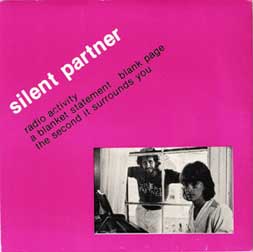 Right: Silent Partner 1981 Radio Activity EP