|
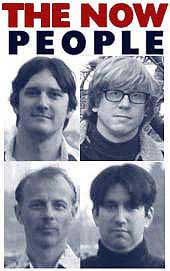
E.C.: The new The Now People album "The Last Great Twentieth Century Love Affair" is incredibly dense -- multi-layered beyond belief, actually -- and yet still loaded with plenty of identifiable hooks and choruses. What was the driving force behind the creation of this album? Steve Stanley: I've always wanted to make this kind of detailed, almost baroque record, like the kind of stuff I listened to as a child going through my mother's extensive record collection; working with musicians who could identify and execute such a thing has been a real gift for me. E.C.: Who was involved in the recording of this album? Steve Stanley: The CD was recorded with the four of us in the core band: Nelson Bragg on drums, percussion and backing vocals, Ruby Rubens on harpsichord, keyboards, bass and backing vocals, Probyn Gregory on horns, banjo, and assorted musical goodies, and myself on guitar, keyboards and lead vocals. Scott Halper also played bass on three tracks. The string section features Julie Carpenter (from Listing Ship), Anna Lenchantin, and a couple of other players (I really need to get their names!). The strings were conducted by my old band's (Single Bullet Theory) drummer, Joachim Kuipers, from Germany. E.C.: Listening to the record closely a few times, I¹d have to say that this album's production and songwriting values remind me as much of Richard and Karen Carpenter as anything else. The level of attention to detail, the incredible musicianship, the perfect harmonies and counter-melodies, the evocative horn arrangements, all the great harpischord and keyboard work, the solid bass playing, the pristine sound/EQ/panning/engineering -- everything about this record somehow reminds me of The Carpenters. Throw in a little Pet Sounds-era Brian Wilson, a heaping tablespoon of Paul Williams, the songwriting chops of Tony Romeo, a large dash of classic Jimmy Webb, a sprinkling of Bacharach/David, and just a hint of The Beatles, and viola! The Now People. Steve Stanley: Thanks for the Carpenters reference. The harpsichord -- built by Ruby Rubens -- certainly adds to that Partridge Family/Carpenters vibe. I guess the attention to detail explains why it took us so damn long to finish this record! E.C.: The title track is immaculate, perfection the Partridge Family could've scored a hit with this song -- and the cool "I Am the Walrus"-style outro is a nice touch. I enjoy song endings that are unique unto themselves (ie. totally different music than the body of the song); how do you approach ending a song? Steve Stanley: I love that kind of thing too, where the end of a song is like a song unto itself, although I suppose with songwriting, I try and be as economical as possible, even with something a little more adventurous like "20th Century Love Affair." E.C.: The 3/4 time-change at the two-minute mark of "A New Life for Us" is a classic songwriting device; you don't hear much of that kind of writing these days. Steve Stanley: That particular track was recorded and produced by Nick Walusko (Brian Wilson, Wondermints); he added a lot of the surreal sounds in the waltz time break; we wanted to go for a "Susan" (Buckinghams) kinda vibe, where a sound collage is enveloped by the song, taking you to a new place for that particular moment in time. I'm happy with the way it turned out. E.C.: Many of your songs are evocative of the classic pop songwriting of the early 1970's; is that intentional? Steve Stanley: That's the kind of vibe that hit me early on when I was a kid in Oklahoma, that "lovers in a custom Chevy Van on the beach at sunrise" feeling. When I was growing up, every one else was watching football; I just wanted to listen to my mother's record collection. So, in my own way, I try to write music that reflects those influences without being too obvious about it. E.C.: One of my favorite songs from the album is "Find a Way". Your drummer Nelson does an unexpected fill at the 1:09 mark; it almost sounds like a mistake but it fits perfectly. You must've been grinning from ear to ear when you played that back for the first time. Steve Stanley: That song was produced by Darian Sahanaja (Brian Wilson, Wondermints, Heart). The fill wasn't a mistake. I think we played it through a few times and stumbled upon that odd fill and recorded it that way intentionally. E.C.: I also love the harmony section of "This Road..." at 1:56 that leads to an unexpected key modulation another songwriting device that sets you apart from many of your contemporaries. Steve Stanley: I like modulations when they aren't noticeable, more of a "feeling" I guess. Any songwriter worth their salt can point out a modulation from a mile away, so I try to be a little more subversive, trying to sneak them in at moments you wouldn't expect. E.C.: It's a testament to your songwriting that your cover Roger Nichols/Paul Williams "Trust" sounds like you could've written it. Steve Stanley: That song has always been a favorite of mine and Ruby's. A few years ago we were asked to perform at a Paul Williams tribute show. It was cool because Paul attended performed at the show. We performed "Trust" and we liked the tune so much we made it a part of our regular live repertoire. We decided to morph the horn and string arrangements from two separate versions of the song: the Paul Williams version (which can be found on 1971's "Someday Man") and the Peppermint Trolley Company version (they released a self titled LP in 1968; they recorded the TV theme songs for Love American Style and the first season of The Brady Bunch as well.) I think it turned out pretty interesting. I got to play it for Roger Nichols himself. That was a big thrill. E.C.: You really show your mastery of songwriting with the 1920's-style "Old and Gray"; that song is so off the beaten path in today's musical world, it's not even funny. How did you get that totally vintage-sounding 78RPM recording? Steve Stanley: Brad Gordon (The California Navels) produced and arranged "Old and Gray." We recorded my vocal and Nelson's drums at Brad's house. Brad is truly a brilliant musician, a really superb arranger and musician. Ruby was the key force in the gradually shifting the "lo-fi" to "hi-fi" section without it being too jarring; that was an incredible move on Ruby's part. E.C.: The closing track "Buzzing By" is simply beautiful; your heart-wrenching vocals, your sparkling acoustic guitar licks, the gorgeous dissonant acoustic guitar strum at the 1:18 mark pretty damned spectacular! Steve Stanley: Thanks. I think this one might be my favorite on the album. That's Nick Walusko playing the dissonant guitar part you mention. I played the main guitar, but Nick thought that part should be a little darker, a little less sunshine and more clouds, so he tacked it on. He's a master as far as guitar shadings and colors are concerned. E.C.: Have you checked out MySpace yet? Steve Stanley: Just yesterday I got the MySpace music thing going. I had to do a major upgrade to get my G4 to industry standards, but we're all settled in as of now. Visit www.myspace.com/TheNowPeople; we've got some songs up there and more details about the band, etc. E.C.: This is a fine album, congratulations. This is music that isn't insulting to the listener a rare thing these cut-and-paste days. Steve Stanley: Thanks, I'm flattered. I know what you mean about the cut-and-paste thing; you hear it all the time today. Personally, I prefer songwriting that incorporates multiple sections, non-repeating parts, all the hallmarks from the classic era of pop song-craft. I guess you could call me old fashioned.
EAR CANDY:
|

 Intro: